 Lire l'actualité
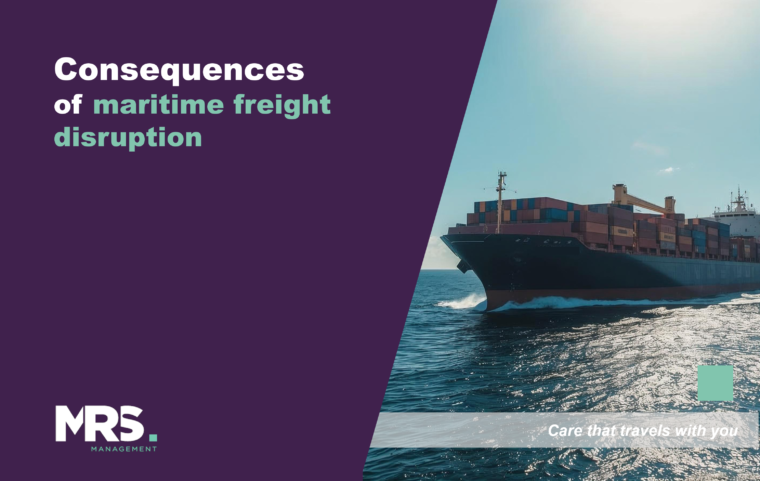
Consequences of maritime freight disruption: rerouting, delays, rising costs, and capacity scarcity
Recent developments in the Strait of Hormuz have triggered a significant escalation in maritime risk, with oil tankers increasingly avoiding the passage ahead of a newly announced U.S. blockade and growing geopolitical tensions affecting transit through one of the world’s most critical energy chokepoints.
Maritime freight remains the backbone of global logistics, particularly for long-distance relocations and international trade flows. However, when key maritime routes become unavailable – due to geopolitical disruptions, port inactivity, or blocked passages – the impact cascades across the entire supply chain. The consequences are not only operational but also financial and emotional for clients and shippers alike.
Recent developments have further intensified this reality.
The Strait of Hormuz is experiencing severe operational disruption, with restricted traffic, active rerouting, and escalating military intervention impacting commercial shipping. This situation has amplified volatility across freight markets, particularly affecting Middle East routing, pricing stability, and vessel availability.
The impact is also visible in global energy markets, where the latest escalation triggered a sharp reaction in oil prices, with Brent crude futures rising by approximately 8% in early Asian trading, from $95.20 on April 10 to $102.80 per barrel.
Freight rates have surged sharply due to limited capacity and increased fuel costs:
- ~USD 2,500 for a 20’ container
- ~USD 4,000 for a 40’ container
- ~USD 10 per m³ for LCL shipments
Shipping companies cite geopolitical tensions and fuel price increases as justification for these surcharges. Price quotes have become highly volatile and difficult to secure, especially from key hubs such as Jebel Ali.
Exports from the UAE are temporarily suspended in certain flows, while imports are less affected. Packaging and storage operations continue, but vessel departure dates remain uncertain, creating a high level of operational unpredictability.
At the same time, travel risk exposure has significantly increased. Immigration processing delays are expected, and duty-of-care obligations require urgent reassessment. Major airports, airspace corridors, and critical Gulf infrastructure are significantly impacted, affecting both employee mobility and supply chain continuity. Organizations are advised to closely monitor developments, adjust travel and shipping plans, and proactively communicate with employees and partners to mitigate disruption.
This analysis explores the key consequences of maritime freight disruption, illustrated through real operational scenarios and logistics practices commonly used in the industry.
Rerouting: “Passing through elsewhere” becomes the new normal
When a maritime route is blocked or a port becomes inactive, vessels are forced to reroute through alternative hubs. While this ensures continuity, it introduces:
- Longer sailing distances
- Additional transshipment points
- Increased handling risks (damage, loss, delays)
- Dependency on third-party port availability
Instead of a direct routing (e.g., Dubai → destination port), cargo may be redirected through alternative hubs such as Colombo, Khor Fakkan, Fujairah, Salalah, or Sohar before final delivery.
This rerouting often creates a domino effect across the global network, where congestion shifts rather than disappears.
Longer transit times = operational frustration and uncertainty
One of the most immediate consequences is time inflation.
Delays are caused by: waiting for vessel reallocation, port congestion in alternative hubs, rebooking of maritime space, additional customs or handling procedures.
For mobility programs and personal effects shipments, this translates into:
- Uncertain relocation timelines
- Frustration for relocating employees
- Disruption in housing, onboarding, and family logistics
The psychological impact is often underestimated: uncertainty becomes a major operational burden, especially for corporate relocations.
1. Rising costs: fuel, rerouting, and “hidden logistics inflation”
Maritime freight disruptions significantly increase total landed cost due to multiple factors:
a. Higher fuel consumption
Longer routes and detours increase bunker fuel usage, directly raising carrier costs.
b. Emergency routing fees
Shipping lines often apply: diversion fees and emergency handling surcharges.
c. Storage and handling accumulation
When cargo is stuck in transit: Warehouse storage fees accumulate daily, insurance costs increase, additional handling charges apply at every transfer point
2. Scarcity of transport capacity and rising market rates
When maritime flows are disrupted:
- Vessel availability becomes limited
- Container repositioning slows down
- Priority is given to commercial freight over personal effects
This leads to reduced access to containers, higher spot market pricing, increased competition for vessel space, volatility in booking confirmation and lead times.
As a result, transport becomes not only more expensive but also significantly less predictable.
Carrier response strategies and “land bridge” solutions
In response to Gulf disruption and rerouting constraints, major shipping lines and logistics providers have implemented multimodal and land-bridge solutions to maintain regional connectivity.
MAERSK – “Land bridge solution”
From: Jeddah / Khor Fakkan / Fujairah / Salalah / Sohar
To: Bahrain, Kuwait, Qatar, UAE, Oman, Saudi Arabia (KSA)
This solution leverages regional port connectivity combined with land transport corridors to maintain Gulf distribution flows despite maritime instability.
MSC – “Land bridge solution”
From: Jeddah / King Abdullah Port
To: Dammam, Jubail, Riyadh, Bahrain, Kuwait, Hamad, Jebel Ali, Abu Dhabi
MSC provides extensive inland and port delivery options across the Gulf, integrating trucking and feeder services to bypass congested maritime nodes.
CMA CGM – Multi-route flexibility solutions
From: Malta, Jeddah, Khor Fakkan
To: Jeddah, Jebel Ali, Abu Dhabi, Doha, Dammam, Khalifa, Bahrain, Kuwait, Iraq, Qatar
CMA CGM deploys combined feeder, trucking, and REDEX solutions, offering flexible routing between main hubs and inland destinations depending on operational constraints.
COSCO – Controlled reopening strategy
COSCO has resumed container bookings to most Gulf countries except Iran, following assurances from the Iranian Ministry of Foreign Affairs.
Non-hostile vessels are allowed to transit the Strait of Hormuz under coordinated supervision, indicating partial stabilization but continued risk management.
First transit under blockade
On April 14, 2026, the Rich Starry – a Chinese-owned tanker operated by Shanghai Xuanrun Shipping and under U.S. sanctions for transporting Iranian oil – transited the Strait of Hormuz carrying approximately 250,000 barrels of methanol loaded in the UAE. The vessel followed a route along Iran’s Larak Island, suggesting coordination with regional transit mechanisms. U.S. Central Command, for its part, maintained publicly that no ships had successfully breached the blockade in its first 24 hours – a claim contradicted by independent maritime tracking data from LSEG and Kpler.
Operational consequences for relocation logistics (real scenario framework)
In practice, logistics providers must adapt through contingency planning when ports are inactive or passages are blocked:
Option 1: Delay of departure:
Postponing employee relocation until routing stabilizes
Option 2: Storage in transit:
Packing the shipments in Dubai or abroad and arrange storage in transit while waiting for a vessel to become available to transport the personal effects (additional costs for warehouse handling, storage in transit, and storage insurance). Rates vary depending on the country.
Option 3: Partial air shipment
Depending on the volumes to be shipped and the personal effects, a small volume may be allocated to air freight, subject to the availability of commercial flights at the time from/to Dubai. This remains at the discretion of the airlines.
Option 4: Container diversion or return routing
If a container is already in transit to/from Dubai, a solution may be to temporarily return the container to the sender and store the personal effects in a bonded warehouse, or to reroute the maritime container to the employee’s country of nationality (this may be subject to duties and taxes upon arrival in the destination country.)
Real case illustration: Sydney → Colombo disruption
A practical industry example illustrates the complexity of rerouting decisions.
A container originally shipped from Sydney was stopped in Colombo due to maritime disruption. Multiple options were assessed:
Option 1: Return to Sydney + re-export later
- Additional freight and handling costs
- Daily terminal storage charges
- Warehouse unloading and reloading fees
- Storage and insurance charges
- Final estimated total: ~USD 10,000+ with ongoing exposure
Option 2: Reroute to the United Kingdom (Nationality-based option)
- Change of sea freight
- Daily terminal storage charges
- High customs duties and VAT exposure
- Unloading sea container to a secure storage in London
- Storage, handling and insurance in London
- Sea Freight from Felixstowe to Jebel Ali
- Final estimated total: ~USD 20,000
Option 3: Reroute to UAE (Khor Fakkan)
- Container unloading at the Port of Colombo (Sri Lanka)
- Additional sea freight from Colombo to Khor Fakkan (UAE)
- Additional administrative fees
- Port storage while awaiting a vessel from Colombo to Khor Fakkan
- High uncertainty in vessel timing
- Port storage while awaiting a vessel from Colombo to Khor Fakkan
- Increased storage exposure risk (humidity, seasonal conditions)
- Estimated total: ~USD 10,000 with variability
This case demonstrates how maritime disruption forces decisions balancing: Cost efficiency, time sensitivity, risk exposure, customs implications.
The broader structural impact on global logistics
Beyond individual shipments, maritime disruption creates systemic effects:
- Inflation in global logistics pricing
- Increased insurance premiums
- Greater reliance on multimodal transport (air + sea hybrid models)
- Higher need for contingency planning in HR mobility programs
- Strategic diversification of ports and routes
In essence, disruption shifts maritime logistics from a predictable system to a dynamic risk-managed network.
Conclusion
Maritime freight disruption is not simply a delay issue – it is a multi-layered economic and operational shock. It increases costs, reduces capacity, extends transit times, and forces companies to adopt complex rerouting strategies.
For relocation and mobility services, this means that flexibility, contingency planning, and real-time logistics decision-making are no longer optional – they are essential.
Sources:
Reuters: Oil tankers steer clear of Hormuz ahead of US blockade
Reuters: Trump returns to weary and failing playbook with Hormuz blockade threat
The Guardian: Maritime insurers cancel war risk cover in Gulf as Iran conflict disrupts shipping
Newsweek: First Tanker Makes It Out of Hormuz Amid US Blockade and It’s a Chinese Ship
Al Jazeera: Sanctioned tankers transit Strait of Hormuz amid US blockade
Reuters: Strait of Hormuz traffic barely affected on first day of US blockade, data shows
Articles associés
Lire l'actualité
 Lire l'actualité
 Lire l'actualité
 Lire l'actualité
 Lire l'actualité
 Lire l'actualité
 Lire l'actualité
 Lire l'actualité